
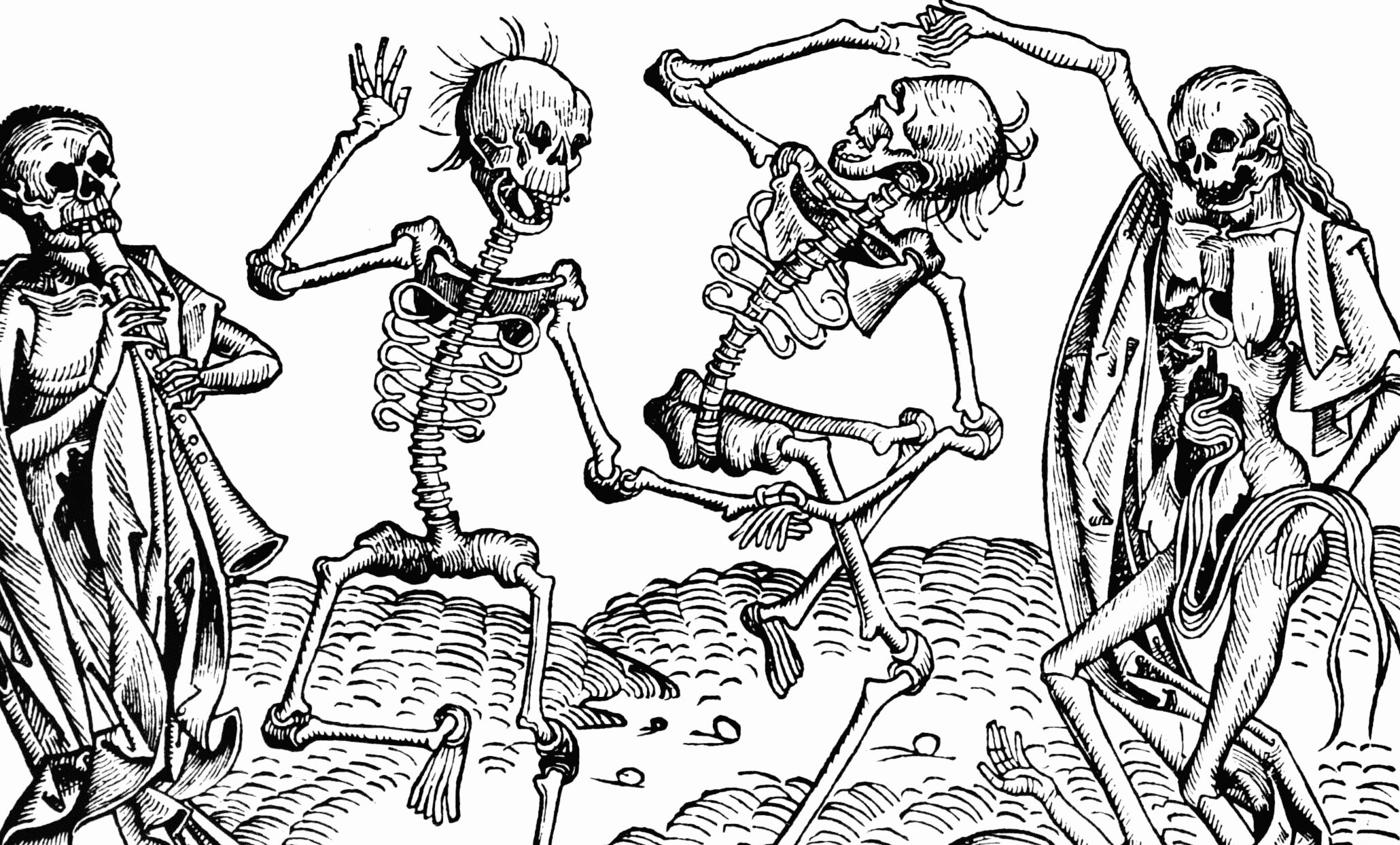
I think every writer has a couple quotes that they keep close to their heart, but if I had to pick the one that sums up my approach to fantasy, it’d be this: “It’s not a good day unless you talk about death.”

It sounds morbid, doesn’t it? Maybe it brings to mind white bicycles chained to stop signs by the roadside, or mass graves filled with cement, or an empty chair at a dinner table.
If anything could offer a distraction, an escape from mortality, it seems that it would be fantasy. And yet, one of the most beloved characters in the genre is Terry Pratchett’s Death, who’s known for exchanges like this:
“All right,” said Susan. “I’m not stupid. You’re saying humans need…fantasies to make life bearable.”
REALLY? AS IF IT WAS SOME KIND OF PINK PILL? NO. HUMANS NEED FANTASY TO BE HUMAN. TO BE THE PLACE WHERE THE FALLING ANGEL MEETS THE RISING APE.

I don’t think it’s a coincidence that Pratchett’s Death is used as a commentator on human nature or the meaning of life—life is precious because it ends, and the knowledge that there is an end forces one to ask how they should spend the time granted to them. This contemplation may lead one to ponder deeper, abstract things, like legacy, love, and the way our lives intersect with others.
But it’s easy to lose that perspective and get immersed in the here-and-now—the practicalities and stresses of day-to-day life, the pettiness, the worries, the guilty pleasures. Before you know it, abstractions like love and mortality seem insubstantial, and you forget why they mattered in the first place.

To me, fantasy is a way of regaining perspective by submerging oneself in another world and returning to this one. Some readers may dismiss the intricacy of secondary worlds as excessive or self-indulgent, but I believe that expanding one’s mind to absorb and assimilate wondrous concepts, elaborate cultures, and esoteric rules loosens the mind from its familiar fetters.
Of course, no fantasy world can be wholly divorced from this world. Instead, it’s up to the creator of the secondary world to pick what they want to borrow, resculpt, or remix, and what should be created from whole cloth. The world I’ve created shares elements and patterns found in our own world: the hidden ways commerce shapes the lives of people and cities, the desire to subjugate nature to serve human needs, and of course, death.

In my world, death is everywhere, and the fear of it has bred a desperate hunger for stability and permanence, exemplified by the Great Schools of immortality. In the Schools, humanity’s deepest desires are transmuted into wonders and horrors, because the pursuit of immortality is the pursuit of perfection, and it’s the pursuit of perfection that lays bare the distance between the human soul and eternity.
In this way, the topic of death becomes a route to talk about humanity—its flaws, its beauty, and its nature. In my mind, death is a mirror—it forces reflection, both for the inhabitants of my fantasy world and our own. The longer one gazes into that mirror, the deeper we seem to go, both into ourselves and the vastness of the abyss. This echoes another one of my favorite quotes, from Franza Kafka:
“The truth is always an abyss. One must—as in a swimming pool—dare to dive from the quivering springboard of trivial everyday experience and sink into the depths, in order to later rise again—laughing and fighting for breath—to the now doubly illuminated surface of things.”
My hope is that when readers emerge from my world, they may gain some kind of insight into themselves, into the world, and what it means to be alive. But to make sense of living, we naturally have to be acquainted with death.

Leave a Reply