

Alchemy has permeated the fantasy genre so deeply that it’s become a stock element, from alchemist shops in Dungeons & Dragons to the Alchemy skill in The Elder Scrolls. It was even a central element of Season 4 of the Castlevania animated series, which focused on a character directly inspired by the alchemical figure of Count Saint-Germain (whose famous Triangular Book is a fascinating real-life artifact).

For years, I’ve been looking for a reliable guide to the underlying concepts and symbolism of alchemy, which is known for using an extremely complex and obscure language of symbols and motifs. So when I saw Taschen had a book on alchemy and mysticism, I picked it up. Taschen’s books have done a great job of combining full-color images with well-researched summaries of complicated topics, so I was excited to see what the book contained.
I wasn’t disappointed.

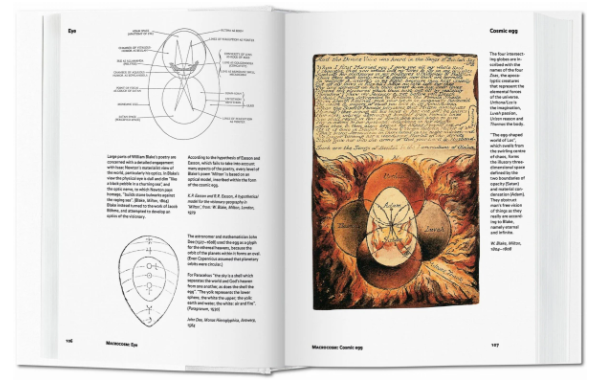
Alchemy & Mysticism is richly illustrated, wide-ranging, and dense with detail. Not only does it give background on the development of hermeticism from its birth in Alexandria to its arrival in Western Europe, it meticulously dissects the alchemical process, placing obscure names and terminology in their individual contexts.

It also pulls on various threads connected to hermeticism, including the work of William Blake and Albrecht Dürer, the influence of alchemy on early science and German Romanticism, and the growth of related occult traditions like Kabbalah and Rosicrucianism. For anyone wondering why and how different esoteric systems echo one another, I think this book is a decent introduction—although the poetic prose and sheer density of references can be difficult to follow for a beginner.

It’s difficult to express the depth and range of the gallery of images—from fundamental concepts like light and darkness, microcosm and macrocosm, to more specific topics like the construction of the eye or the symbolism of the Ouroboros, the book usually provides six to ten illustrations, each accompanied by captions and supplemented by a page or two of text when the subject is important enough. At over 500 pages, it’s a treasure house of art and ideas.

Words & Symbols
Two early passages from this book sum up the central problem of delving into the topic of alchemy. The first comes from Alexander Roob:
“Anyone who inadvertently enters this linguistic arena will suddenly find himself in a chaotic system of references, a network of constantly changing code-names and symbols for arcane substances, in which everything can apparently mean everything else…”
For example, Saturn is the Roman name for the Greek god Chronos. But Saturn is also the name of one of the seven classical planets, and is associated with the metal lead and the stage of putrefaction within alchemy—the lowest strata of the process, and the furthest from the Magnum Opus and enlightenment. Saturn is also associated with death and the underworld…but also the promise of eternal life:
“The alchemist’s journey required him to pass through that outermost circle of the underworld—the serpent’s circle of Saturn. Saturn is identical to Chronos, the Greek god of time, and in overcoming him one has broken with transient, sequential time and reverted to a Golden Age of eternal youth…”
And so Saturn is associated with both the beginning and the end of the Great Work of alchemy—it is both the furthest from the peak of alchemy and essential for its completion. This conflation of top and bottom, beginning and end, ignorance and enlightenment echoes the Emerald Tablet, the foundational text of alchemy:
A Truth without doubt, wholly sound
That the highest is from the lowest
And the lowest is from the highest.
The working of wonders is from the one
Just as all things came from the one
By a single governance
The dissolution of opposites becomes confusing because language depends on differentiation and difference, and according to Alexander Roob, one of the chief reasons that alchemy invested itself so heavily in symbols wasn’t only to prevent the unworthy from understanding profound occult secrets, it was because there was a persistent belief that common words were insufficient to express deeper truths.
Hence, the reliance on images, intuition, and codes—according to the Rosarium Philosophorum, Weinheim edition, 1990:
“Wherever we have spoken openly we have (actually) said nothing. But where we have written something in code and in pictures we have concealed the truth.”
The reliance on direct experience and intuition echoes the Zen idea of pointing at the moon, as well as the Taoist adage “The Tao that can be expressed in words is not the eternal Tao.”
Conclusion
Alchemy & Mysticism is an excellent reference book and guide through the intricate symbolism of alchemy and hermeticism more generally, and provides a helpful overview of the tradition’s interpenetration with other movements, whether artistic, occult, or scientific.
Leave a Reply