
This is part of an ongoing series about the worldbuilding of the Lab’s dark fantasy setting of OROBORO. You can read more about the world here.
The desperate desire to stave off death lies at the heart of the world of OROBORO, for death means becoming a half-mad ghost for eternity, clinging to old memories and passions while slowly slipping deeper into madness.
But there is the promise of salvation: three grand, esoteric schools exist, each of which has mastered a different form of immortality. Today, I want to talk a bit about the inspirations for the immortality schools and Togorun, the founder of the oldest school, which seeks to create immortal bodies.
Giger, Monocyte, and the Immortality Schools
Initially, the schools were inspired by the Greek mystery cults, then later by esoteric traditions like Gnosticism and Vajrayana. In my mind, the schools were powerful, tenebrous organizations that jealously guarded the secrets to eternal life.
Another influence was H.R. Giger’s Necronomicon. Giger’s art was often bleak and post-apocalyptic, depicting landscapes that had been stripped bare, apparently from overpopulation and overconsumption. In Giger’s worldbuilding, birth has become infinitely more destructive than warfare, and those who survive do so underground, melded with machines to become biomechanical beings.


Survival in Giger’s world seems to necessitate transhumanism, and I held onto the idea that to become immortal, one had to transcend the limits of humanity and become something inhuman.
Around the same time, I was introduced to Monocyte, a surreal graphic novel influenced by Giger’s work. Monocyte portrayed a world where immortality created a never-ending, war-torn hellscape where cabals of immortals used endless ranks of disposable, resurrected soldiers to wage war on one another. In the world of Monocyte, death was a rare and frightening thing. Into this eternal stalemate came the Monocyte, the embodiment of death, to return the world to equilibrium.

The idea of competing immortals fighting for dominance sparked the idea for rivalry between the schools, who were not just content with eternal life—they wanted power, prestige, and pleasure.
Both the Necronomicon and Monocyte suggested that the achievement of immortality by humanity wouldn’t result in harmony or paradise—instead, all the flaws of humanity would be magnified. This idea was a major influence on the immortality schools of OROBORO and Togorun himself.
Inspirations for Togorun & the Itzon School
Togorun was meant to represent the negative archetype of a magus: someone who learns the workings of magic and the cosmos to serve his own ambitions and ego, rather than out of a love of wisdom or a desire to promote harmony. Although he clothes himself in the trappings of knowledge, he is not a sage.
Togorun sees the problem of immortality as a wholly physical one—the soul and mind are already eternal, but the body is not. Togorun’s school of thought believes eternal life can be achieved by fortifying the body against disease, decay, and trauma with the art of physiomancy, a blend of surgery and spellcraft.
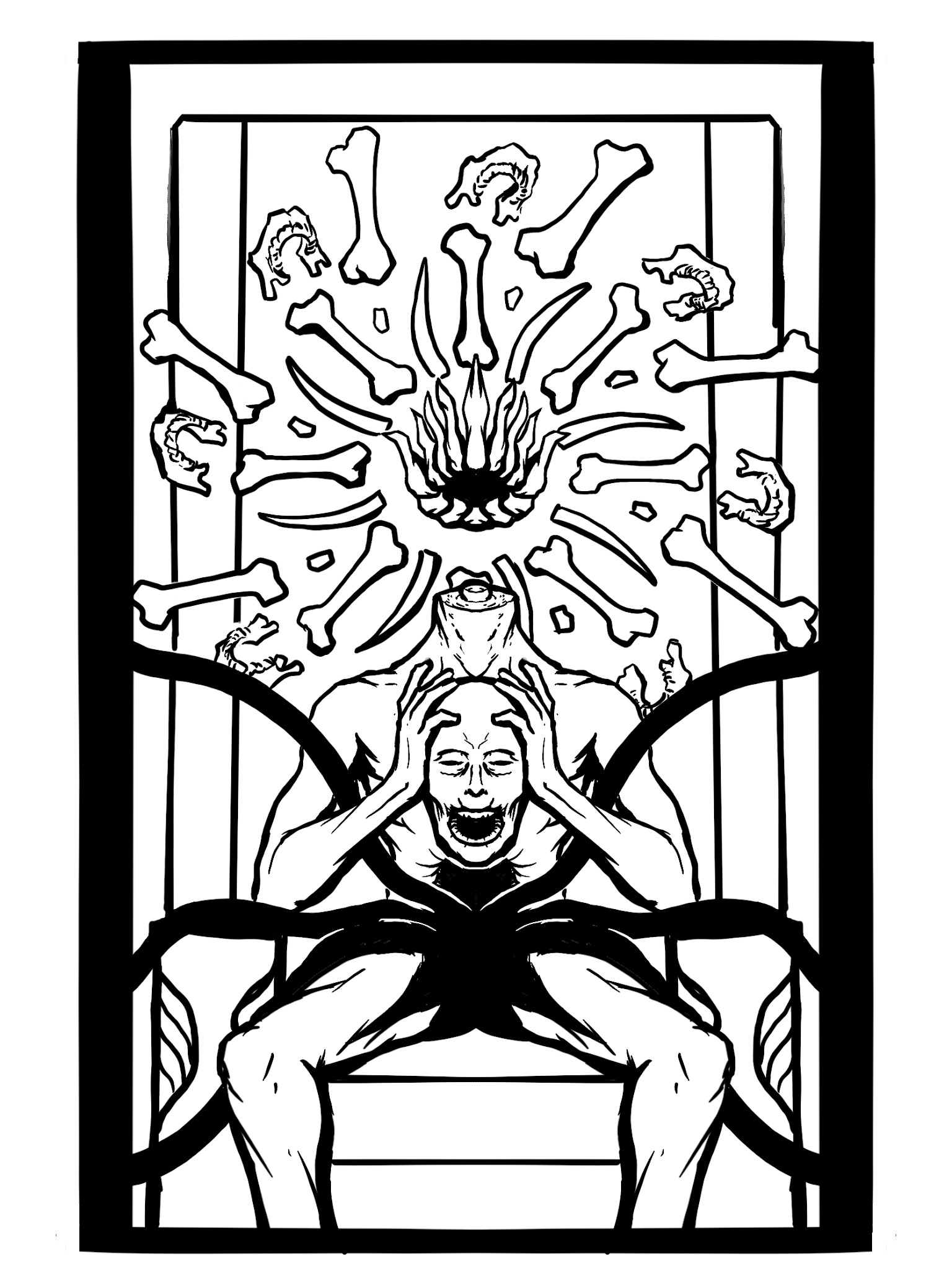
The signature achievement of Togorun’s school of immortality, Itzon, is the “Crownless King”, the ability to remove one’s own head without dying. The Crownless King is presented as a symbolic surpassing of the body’s natural limits, but its true nature is darker and more complex.

Before physiomancy, immortality scholars used another route to extend their lives: cannibalism. They discovered that consuming the flesh and blood of others restored their vitality and youth, but at the cost of an ever-intensifying hunger. Although it was only intended to be a temporary solution, cannibalism became intrinsically linked with the study of immortality.
In time, the cannibalistic scholars devolved into flesh-crazed monsters, forcing their colleagues to forbid any further cannibalism. The Crownless King became the ultimate guarantee of a scholar’s obedience to this edict: without a head or mouth, a scholar could not cannibalize others. Their head would be kept in a cage, directing their body to perform its usual functions.
Togorun, the Mad King
But generations later, the true nature of the Crownless King has been forgotten: headlessness is considered a mark of wisdom and transcendence, not a safeguard against humankind’s darkest urges.
Meanwhile, Togorun’s assumptions about the eternal nature of the mind have proven wrong: the longer one lives, the more the mind is stretched and warped by the weight of its experiences and memories, driving one to a kind of madness that is eerily similar to that of a ghost.
Togorun himself is creeping toward madness, seated on a throne beneath his school, directing hundreds of drone-like bodies connected by umbilical cords to his own. Each of these drones bears a facet of his mind, and all of them work toward inscrutable goals.

The ultimate fate of Togorun and the influence of his school, Itzon, are explored in the world of OROBORO.
Leave a Reply