
If I had a nickel for every fictional table game played in a fantasy or sci-fi setting, I’d have a lot of nickels—Star Wars’ Dejarik and Sabacc, Game of Thrones’ Cyvasse, and most famously, The Witcher’s Gwent, to name just a few.
The world of OROBORO has its own as well—Dogen, a chess-like game with a twist. I wanted to talk about how the game works and the role it plays in my stories.

What is Dogen?
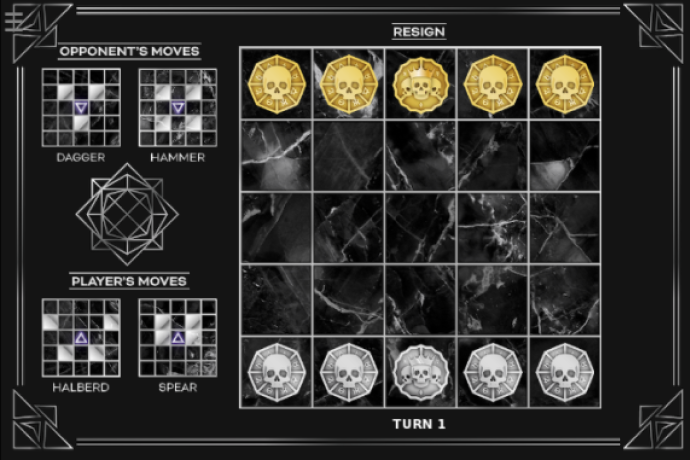
Dogen is a board game where players control five pieces—four pawns and a general. The object of the game is to capture the opponent’s general, similar to chess.
Each player chooses two cards at the start of the game with movement patterns on them, and each turn, they choose one card, which they use to move one of their pieces.
At the end of the turn, a player passes the card they used to their opponent, creating a cycle of using and passing cards that forces both players to continuously adapt and think ahead.
The game is meant to simulate a battle between armies, with movement cards symbolizing the fighting styles of armies based on their chosen weapons.
How Did Dogen Evolve?
Dogen was inspired by Onitama, a martial arts tactics game that’s intuitive to learn but difficult to master (check it out here!). I played a lot of games of Onitama against friends, and I started developing a variation called “Seeker,” where one player played with two pawns and a Master against an opponent with only one piece: an invisible Master.
This variation became the inspiration for the idea of “the Lotus Gambit” (explained later), and for a playable mini-game in the Lab’s first major project, Black Heaven: A Necromantic Dating Sim, a dark fantasy visual novel (you can check that out here).

A digital, one-player version of Dogen was created with the help of Lynn Zheng, a programmer and game dev, who took the rules of the fictional game and adapted them for a modified version of Stockfish, an open-source chess engine.
This version of Dogen was used as the mini-game Black Heaven. Each of the main characters had a set of cards they would use in the game, and the player would play against them multiple times during the story.
The Black Heaven version of Dogen doesn’t have the card-swapping mechanic of the fictional game, primarily because we discovered that certain card combinations led the game’s AI to make worse moves or surrender too easily.
We actually used this “glitch” to make certain characters easier or tougher opponents, tying their personalities into the difficulty—in the game, Izagi Ito is portrayed as too impatient to think strategically, making her an easy opponent, while Ru Okazi is a very abstract, theoretical thinker, making her a tougher adversary.
The “invisible master” aspect of Seeker didn’t make it into the digital version game because it ended up being too difficult: new players had a hard time predicting moves, and the AI was unpredictable to begin with. Since the whole point of Seeker was that you could put yourself in the mindset of your opponent to anticipate their moves, that was important!
How It Fits Into Stories
I’m a terrible chess player, but I’m fascinated by stories and writings about the game, particularly Mikhail Tal’s quote about the mind-games he would play with his opponents: “You must take your opponent into a deep, dark forest where 2+2=5 and the path leading out is only wide enough for one.”
I was enamored with the idea that a person’s unique playstyle could reflect who they were, so that watching them play a game could be akin to inspecting a Rorschach test. That became the inspiration for the Lotus Gambit, a variation of Dogen where one player plays blindfolded, with their only aid being a paper lotus folded by their opponent.
The idea is that each person is the sum of all their flaws, and everything a person does is an expression of who they are, so when they fold a paper lotus, you can read their flaws in it, sort of like reading a palm. If they’re able to read their opponent’s lotus and divine their personality and mindset, a player can predict what that person is going to do before they do it, allowing them to play Dogen against them without seeing the board or pieces.
This ended up becoming the central conceit of one of my short stories, aptly named “The Lotus Gambit”. It also played a major role in the narrative of Black Heaven, in which the main character, Uzo, reads the lotuses folded by his friends to gain insight into their personalities, fears, and desires.
Want to try your hand at Dogen? Play it on the site!
Want to read a story about Dogen?

Read “The Lotus Gambit” on the Occult Triangle Lab or on Kindle.
Summary:
Everyone builds their own prison within their mind.
In the freezing depths of a secluded prison, a blind, silver-tongued criminal named Yute challenges Shiro, his ambitious but frustrated jailer, to an impossible bet: he claims he can beat her at a game without seeing the board or pieces.
To accomplish this, Yute asks Shiro to fold a paper lotus, claiming that by examining the folds, he can learn the shape of her soul and predict her moves before she makes them. As the game unfolds, Shiro is faced with a disquieting question: Does Yute know her better than she knows herself?
But when the board and pieces are put away, the true game reveals itself.
Leave a Reply