
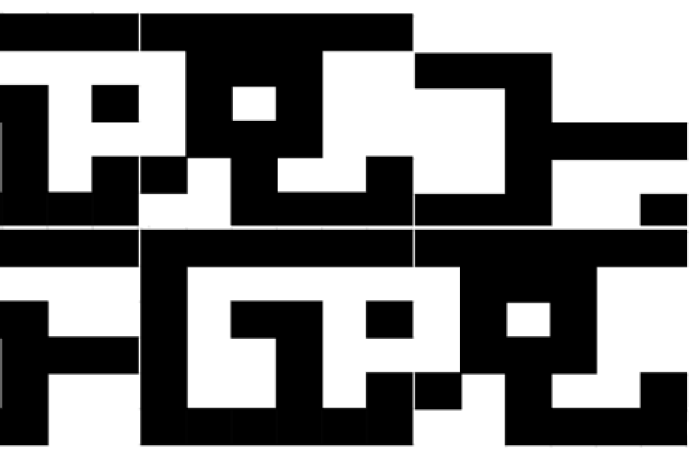
Carl Sagan once said “If you wish to make an apple pie from scratch, you must first invent the universe.” He was trying to express how even something as seemingly simple as a pie can only be created through the interplay of matter, energy, and the laws of nature, all of which arise from the structure of the cosmos.
I think about this quote a lot when I write fantasy, particularly when I’m working on magic-building, because in a way, everything in the world (fantasy or otherwise) is a reflection of the whole cosmos: leather shoes, hurricanes, bananas, and electricity, all of it mirrors some facet of the universe.
I’ve written a deep dive into how I tie my magic into the themes and narrative of a story (which you can read about here), but in this essay, I want to talk more about the design process of magic-building, my inspirations, and what I think makes for a compelling piece of worldbuilding.
The system I’m talking about in this essay is graphomancy, a magic system used in my fantasy setting OROBORO.
Graphomancy is a kind of magic performed by drawing a “sigil” on the body or an object. The sigil is made up of hundreds or even thousands of tiny glyphs, arranged in symmetrical, geometric patterns. It was inspired by Western occult sigils, Kabbalah, and Buddhist mandalas.
Let’s dive in.
A Philosophy of Magic
First, a word on magic systems themselves.
A ton has been written on the topic of “hard” vs “soft” magic systems—their definitions, their advantages, and how to categorize different authors’ systems. I think either approach to magic can be satisfying and effective, but I think that harder magic systems are more satisfying and effective for the kinds of stories I tell, since the narrative can use their rules and limitations when creating tension, conflict, and plot points.

However, I do not think that magic systems should essentially be a fantastical form of science, either in construction or portrayal. In my view, the nature of magic in a fantasy world inevitably ends up revealing something essential about that setting, and if you simply make your magic an analogue of science, your setting will inevitably drift into becoming analogous to this reality.
If you want to read my full thoughts on that, you can check out this article I wrote for Clarkesworld.
So what should magic be, if not a kind of science? In my view, magic should function as:
- A coherent system of methods to transform your world in imaginative ways
- A way to evoke the fundamental themes of the story you’re trying to tell and the world you’ve built
I think Ursula LeGuin’s Earthsea is an illustrative example. At first glance, Earthsea’s magic seems very simple and taxonomic: if you learn the True Name of something, you can manipulate it, summon it, etc. Mages spend years learning the Names of things, then go out and work magic with them.

The main character of the series, Ged, is eager to use this power to gain fame and power, and the first book in the series shows him slowly realizing that the art of magic is more than just learning a big catalogue of names—it’s the art of understanding and reconciling yourself with the cosmos.
Here’s quote from later in the Earthsea series that sums it up beautifully:
“It is no secret. All power is one in source and end, I think. Years and distances, stars and candles, water and wind and wizardry, the craft in a man’s hand and the wisdom in a tree’s root: they all arise together. My name, and yours, and the true name of the sun, or a spring of water, or an unborn child, all are syllables of the great word that is very slowly spoken by the shining of the stars. There is no other power. No other name.”
We’ll revisit this deeper dimension of magic later on, but for now, know that it lies beneath everything else I talk about.
Inspirations
Let’s start with inspirations—the stuff that sparked the idea of graphomancy. This was a mix of esoteric and spiritual material and geometry (hence the name, Occult Triangle Lab).
Tree of Sephiroth
I remember when I watched Neon Genesis Evangelion and saw this image:


This is Athanasius Kircher’s representation of the Tree of Sephiroth, the centerpiece for the occult tradition known as Kabbalah. I didn’t know that at the time—all I knew was that it looked fascinating. It was so intricate, full of so many symbols and names and interconnections that suggested a complex, ancient lineage. If anything looked like it might be the key to the secrets of the universe, the Tree of Sephiroth was it.
Here it is alone:


The Tree was one of the early things that got me interested in occultism and geometry, and the more I looked, the more connections I found.
Buddhist Mandalas
Case in point, Buddhist mandalas. My favorite museum in New York City was the Rubin Museum, which was focused on Tibetan and Himalayan art and featured a number of mandalas. I loved how the mandala served as a microcosm of the universe, showing the symmetry of the cosmos through geometry and color. I also appreciated the nested layers of meaning and the symbolic placement of the figures.
I was fascinated with how the construction of sand mandalas involved creation and destruction—after meticulously tapping the sand out of copper funnels for hours and hours, the vast, colorful design is wiped away as a demonstration of impermanence.

Goetic Seals
Years ago, I was introduced to the Lesser Key of Solomon by a Finnish game dev, who wanted me to use it as inspiration for his game’s magic system. That magic system never came to fruition, but the Key’s sigils appealed to my love of geometry and esoteric symbolism (including alchemy).
I liked how the dots and lines resembled the shapes of constellations, as if they were mapping invisible stars whose configurations aligned with primal, elemental shapes. The Key’s sigils were also much simpler and self-contained than the Tree of Life or mandalas—they could be drawn with a stick in the dirt, if need be.

Sierpinski Pyramid
Ever since I learned about fractal geometry, I’ve been enamored with it, particularly the Sierpinski Triangle, which mirrors Pascal’s Triangle and a number of other patterns in mathematics. Fractals’ self-similarity—in which a part of the design is the same as the whole design—joins together the finite and infinite by using relatively simple patterns to create complex, dimension-defying figures.
The idea of a single, simple pattern being repeated into giant meta-patterns also aligned with my interest in the concept of the microcosm and macrocosm.


Conway’s Game of Life
Conway’s Game of Life is a fascinating “zero-player” simulation game that mimics a colony of cells growing, dividing, dying, and reproducing. The game is played on an infinite white grid, which can be populated by black squares that represent cells.
The game has rules for how black squares behave when they are adjacent to other squares, which can lead squares to disappear or multiply. A player starts the “game” by placing black squares, then letting the game play out–there are no further inputs by the player.
When I saw the Game of Life, as well as the amazing, automated systems people created with it, all I could think was “oh, someone made a framework for a living mandala.”

Square Kufic
Finally, I was inspired by Square Kufic, a type of Islamic calligraphy that was derived from the standard script for the Quran. The resemblance to both Conway’s Game of Life and Chinese seal script caught my attention, as did the geometric designs created with it, which could range from labyrinth-like squares to spirals.

From all these inspirations, a unified idea began to coalesce: I wanted graphomancy to use sigils that were essentially abstract mandalas, incorporating geometry and symmetry. I wanted each sigil to be a little map of the universe, using Conway’s Game of Life as the foundation.
Design Principles
When I sat down to create this system, I knew I wanted it to be intuitive, elegant, and ordered. Let’s break those down:
Intuitive
I wanted this system’s principles to be easy to grasp, even if the reader isn’t explicitly told how it works. This helps limit the amount of exposition needed in narratives, as well give readers a more visceral appreciation for the system.
Elegant
I wanted the system overall to be as simple as possible, with each layer of it building on the previous one. I also wanted it to feel cohesive, so that every piece of it was internally consistent as well as consistent with the rest of the world.
Ordered
I wanted this system to have an internal logic and set of rules that the reader could understand and extrapolate on. The ability to extrapolate is important, because it means that the reader and characters can start to think of creative ways to use the system.
I decided that the spell sigils should have a form of symmetry—whether rotational symmetry, three-dimensional symmetry, or something else. Similar to the construction of a Sudoku puzzle or magic square, symmetry would be the principle that demonstrated the sigil’s alignment with the cosmos.
Building Blocks
The main building block of graphomancy is the glyph, a symbol made by filling in squares on a six-by-six grid. I used Conway’s Game of Life as the primary inspiration for this, followed by Square Kufic:

These glyphs function like an alphabet, and can be chained together into sentences:

Those sentences can be grouped together into paragraphs:

These paragraphs, arranged as lines, can be used to build shapes:

When looking at the final design, one can image the whole sigil as a symbolic representation of a universe, similar to a mandala:
- Stroke/Dot: Person
- Glyph: Settlement
- Sentence: Region
- Paragraph: Continent
- Shape: Planet
- Sigil: Universe
If we look at this sigil as the beginning configuration of Conway’s Game of Life, then we’ve set the stage for a complex and dynamic session, which will develop in ways that could never be predicted at a glance—something that aligns with the sigil’s symbolic role as representation of the cosmos.
Ultimately, the lines formed by the glyphs could be used to create more complex shapes, like this one:

Conclusion
The idea of a sigil becoming the basis for a metaphysical Game of Life touches on the idea of unpredictable, emergent patterns, something that will come into play later in this series.
Now that we’ve laid the groundwork for the structure and appearance of graphomancy, we can talk about how it works, practically and more fundamentally, in Part 2!
Leave a Reply