
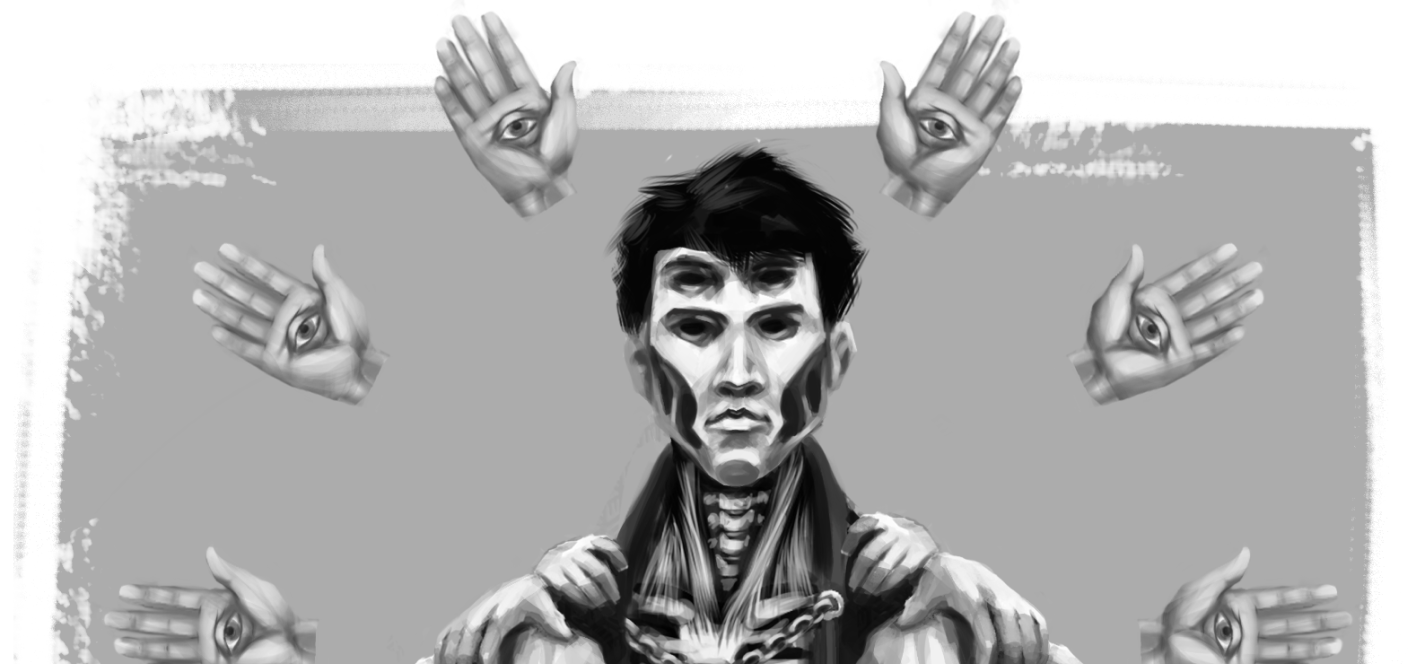
This is part of a series exploring the worldbuilding of the dark fantasy setting of OROBORO.
The city of Senkaku is a crossroads of the living and the dead, of dreams and nightmares, and of art and destitution. It is famed for its elaborate theater shows, its skilled surgeons, and its raucous gangs, but most of all, it is known for the wild ghosts that walk the streets and alleys late at night, searching for entertainment and offerings.
Yoshiza

The original Senkaku was destroyed by a storm of ash, burying its streets and residents under six feet of embers. For over a century, the city’s ghosts wandered the ruins and dreamt of their lost city, until one night when their collective dreams gave birth to the Yoshiza, a surreal version of the old Senkaku where the ghosts could reside in comfort and pleasure.
When the ruins of Senkaku were excavated and rebuilt by later generations, they found that the ghosts violently resisted them—each ruined building that was demolished caused its counterpart in the Yoshiza to be destroyed. To stop the resettlement of the city, the ghosts descended from the Yoshiza each night and hunted the living, terrorizing and possessing them.
The nightly hunts only ended with a deal: the living would restore, not destroy, the city’s old buildings, and the ghosts would cease to hunt the living. In time, the Yoshiza was opened to the living, who could only reach it with the help of lucid dreaming.
Tezuma

Senkaku began as six pit mines dug into the side of a mountain and linked by an intricate network of tunnels. By the time the ore was gone, the terraced inner slopes of the mines were filled with stages, shanties, and shops built by performers, prostitutes, and peddlers who sought to make money off the miners.
As the years went on, the rain formed vast, sky-blue lakes in the pits—toxic to drink, but nourishing to the rare tezu flower. When refined and ingested, the tezu flower made a powerful, intoxicating narcotic called tezuma that granted its users the gift of lucid dreaming.
Soon after the excavation of the old Senkaku, tezuma became the key to its revival—the pit lakes were restored, and tezuma became the city’s largest export, as well as the bridge between the waking world of the living and the dreaming world of the dead. Outside the city, tezuma was deemed to be dangerous, addictive contraband, but nonetheless found eager buyers among the highest and lowest quarters of society.
Hekul
The cultivation of tezuma (and its status as contraband) attracted hekul, secret societies of criminals known for smuggling, extortion, and kidnapping. Driven by greed and ambition, the hekul overthrew the fragile power structure in the new Senkaku and seized control of the tezu lakes, though their loose alliance quickly devolved into infighting and plotting.
Within Senkaku, the hekul are known for their colorful personalities and appearances, as well as their extravagant wealth and penchant for violence and grudges. Each hekul society practices its own craft, which can range from information-gathering and blackmail to kidnapping and torture. Most societies have an intricate set of ranks, roles, and rituals that are never disclosed to outsiders, as well as elaborate forms of dress with hidden symbolism.
Kaozaru

The Kaozaru is the flesh district of Senkaku, home to black-market surgeons and scholar-physiomancers. The district is known for its lax restrictions on human surgery, particularly the use of debtors as living gestation vessels for new organs and tissue. Although gruesome and often unspeakably cruel, the surgeons of the Kaozaru defend their work by producing wondrous new techniques to fight disease, aging, and trauma. For example, the double-heart technique, used by warriors to nourish their hulking muscles, was discovered in the Kaozaru.
Apart from its status as an unrestrained proving ground for new surgical techniques, the Kaozaru is also a key part of Senkaku’s fashion scene—one of the city’s “two living hearts”. In its shops, the city’s residents reshape their bodies to match the trends of fashion and their own eclectic tastes, turning themselves into living works of art.
In addition to the flow of cash from Senkaku’s fashionable residents, the Kaozaru deals heavily in loans to the poorest parts of the city, which are used to pay for new organs, excising cancers, and treating maladies. These loans almost always charge steep interest, and those who default are usually tracked down and kidnapped by hekul debt collectors, who confine the debtors to one of the hundreds of cells beneath the Kaozaru to await three- to five-year stints as living organ vessels.
Want to read a story set in Senkaku?

Read “Hypnotica” on the Occult Triangle Lab or on Kindle.
Summary:
Enter the mind-bending world of dreamwrights—mages who craft surreal musical performances in grand, shared dreams. Dreamwrights split their lives between the waking city of Senkaku, populated by the living, and the dreaming city known as the Yoshiza, inhabited by ghosts whose hunger for entertainment is only matched by their taste for cruelty.
NO-FOOT and GRIN are two such dreamwrights, but their ambitions are dashed when their virtuoso performance goes horribly wrong, forcing them to consider a perilous deal.

Leave a Reply