
Welcome to Part 2 of this series about constructing the magic system for graphomancy! If you missed part 1, read it here.
In Part 2, we’ll talk about the metaphysics of graphomancy, then the process of creating a graphomantic sigil and the dangers of graphomancy.
But before I dive into graphomancy in earnest, I want to return to one of the topics in Part 1: the philosophy of magic-building for fantasy worlds, and how magic intersects with science, meaning, and storytelling.
Low and High Magic
Generally, magic in fantasy resembles what has historically been called “low magic”. The difference between high and low magic is a distinction that most readers and writers don’t know exists, but it’s worth talking about since low magic is likely the only type of magic people are familiar with.
In most western occult traditions, there’s a delineation between “high” magic (sometimes called “theurgy”) and “low” magic (sometimes referred to as “thaumaturgy” or “sorcery”). Low magic is generally used for worldly purposes (gaining wealth, accumulating power, obtaining love, wreaking destruction, etc), while high magic is usually associated with achieving transcendence, enlightenment, or union with God.
But here’s the thing: magic, whether high or low, is often drawing upon the same power or the same cosmic principles.
For example, the low form of astral magic generally claims that certain metals and stones have an affinity with certain planets, which are in fact divine beings who each govern an aspect of creation, such as war, love, or wealth. By making an amulet with the right material, engraving it with symbols and prayers to the right god, and exposing it to the associated planet’s rays at the right time, you can gain the blessings of that god and say, become a more persuasive orator or attractive lover.

On the other hand, “high” astral magic might deal with rituals meant to purify one’s soul for a transcendental journey: the soul’s ascent through the layers of creation, each one represented by a different planet and god. Each planet’s sphere may challenge the seeker with different obstacles to overcome, and upon surmounting them, a person may achieve the benefits and blessings of that god on their journey upward, toward a meeting with the godhead.

In both high and low magic, a mage achieves the benefits of the planets, but through different means and for different purposes. Although both are working with the same powers and within the rules of the cosmos, they are doing very different things.
But when you look at low astral magic, what characterizes it?
It’s very ordered and logical, almost mechanical: it operates on the idea that there is a correspondence between things (metals, planets, gods, and qualities) that unites them in invisible ways, and that by following specific rules and patterns (engraving the right symbols and prayers and exposing the amulet to the correct planet), a person can create an effect.
It’s reproducible, it’s self-consistent, and it follows cause and effect. Even if it’s not following true scientific laws, its character is scientific. If anything could be called “real” or “authentic” magic, astral magic is it. So why, in Part 1 of this series, do I say that magic in fantasy shouldn’t be science?
For a similar reason that theurgists decry sorcerers: when your magic is only concerned with worldly workings, you lose the connection to a deeper truth.
Homeland and D&D’s Magic
As an example of this in fiction, take the Homeland series by R.A. Salvatore, which was directly based on the worldbuilding and gameplay of Dungeons & Dragons: the protagonist, Drizz’t, casts magic spells, but because those spells were crafted for a game system centered on dungeon-crawling, the narrative treats magic mainly as a tool to solve problems, similar to Drizz’t’s swords or other equipment.

Homeland’s magic is definitely low magic, but its real downfall is that it is scientific, designed from the top-down to fit into a game that operates on balanced encounters and modifiers to random number generators. It may incorporate somatic and verbal components and sport mystical trappings, but magic in Homeland has no more depth or meaning than a battery-operated flashlight or a flashbang grenade, and the wonder or imagination that magic evokes is confined to the risk-reward calculations of a dungeon-crawl: using resources and abilities prudently and effectively, which is to say, rationally.
The shallowness of Homeland’s magic is reflected in the story as well: the narrative is mainly about overcoming escalating and well-balanced encounters with enemies, and its protagonist’s angst over being an antihero is outshone by the power fantasy he embodies. I believe magic in Homeland doesn’t say much about its world or narrative because there just isn’t much to say to begin with.
What’s more, the rational construction of D&D’s magic and the mindset it engenders in players are the main reasons why Dungeon Masters constantly run into problems like the Peasant Railgun or Artificers sparking new Industrial Revolutions—rationalized, “scientific” magic tends to lead back to the old systems of thought that science was born from, thus transforming fantasy worlds into new versions of our own world.

It’s no mistake that “magical” practices like astral magic and alchemy were the antecedents of modern sciences like astronomy and chemistry, and lost their deeper meanings related to the soul and perfection of the self as western perspectives on the self and the universe shifted toward positivism, naturalism, and rationalism. The story of science is the death of high magic, but low magic—mechanical, worldly, and lacking profundity—is rational enough to fit into its framework, and thus that becomes the type of magic most modern fantasy authors know and create.
I think it’s telling that J.R.R. Tolkien’s essay On Fairy-Stories says that the unique quality of a fairy-story (his term for what would become the fantasy genre) is that the story itself utilizes a kind of magic to immerse the reader in its world. He terms this kind of storytelling magic “faerie”:
“Faerie itself may perhaps most nearly be translated by Magic—but it is magic of a peculiar mood and power, at the furthest pole from the vulgar devices of the laborious, scientific, magician.”
Here, I think Tolkien is speaking not about the magic used in the narrative, but about the nature of the fantasy world’s construction.
In my mind, a magic system in a fantasy story should be more than a fantastic form of science—it should have both high and low aspects, so that it is both a useful element of the narrative and a link to the deeper themes of the story. It can be a “system”, but that system should resemble the occult more than the scientific.
This idea shaped the foundation for graphomancy in the world of OROBORO.
The Metaphysics of Magic in OROBORO
In many ways, the world of OROBORO is built on the idea of imperfection, and its magic reflects that: practicing magic reveals the hidden imperfections in the mage’s mind and body, causing them to cough up blood, go blind, or devolve into madness.
The only way to prevent these effects is for the mage to perfect the body and mind through self-cultivation. At the end of that road, mages believe, is the achievement of a perfect, immortal body and a boundless, untarnished mind.
But there is a third component to each person, apart from the body and mind: the soul. It is eternal, infinite, and god-like in its power. The soul is the source of a mage’s ability to cast magic, but it is shackled to the body and mind.

Upon death, the soul undergoes a kind of apotheosis when it is freed from the body. However, its transition to godhood is tainted by the mind, which chains the soul to the passions, fears, and memories it knew in life. The soul becomes a ghost, whose latent desires, thoughts, and memories warp reality around it in a chaotic, unconscious, and unrestrained form of magic.
Ghosts are able to practice this primordial form of magic, in which the soul directly changes reality, but the normal practice of magic is quite different. To understand it, I want to draw on one of my magic system’s historical inspirations, hermeticism.
Hermeticism
A key concept within hermeticism (a body of occult thought that encompasses alchemy and other traditions) is the relationship between the “microcosm” and “macrocosm,” particularly the idea that each human is a microcosm of the universe:
“Man is a microcosm, or a little world, because he is an extract from all the stars and planets of the whole firmament, from the earth and the elements; and so he is their quintessence.” – Paracelsus
Historically, this idea has been extended to the idea that parts of the human body correspond to different aspects of creation, even the organs. According Andreas Vesalius, the human form:
“…in many respects corresponds admirably to the universe and for that reason was called the little universe by the ancients.”
It was believed that these correspondences, between the individual and the universal, the mortal and the cosmic, allowed a mage to exert their will on the world around them through the use of symbol and ritual.
Magic was a series of techniques that channeled the will of the mage into the right symbolic offerings, actions, and objects to create a change in the cosmos and turn their will into reality.

According to some schemes, a mage thinks about how they want to change reality, and that thought is transformed into their will, which is a special kind of thinking that is charged with power. That will is channeled through a ritual, which produces the desired effect. The chain essentially looks like this:
Thought -> Will -> Ritual -> Effect
This framework is analogous to how magic operates in the world of OROBORO: it is the mage’s will, located in their soul, that serves as the font of magic.
Metaphysics in OROBORO
If the hermetic view of magic is a map of the body overlaid on the cosmos, then my world’s view of magic looks something like this:

The bottom pyramid represents all things finite—mortality, the temporal world, transience, and imperfection—while the top pyramid represents the infinite—immortality, the eternal, permanence, and perfection.
When performing magic, the mage occupies the point where the two pyramids meet, drawing upon their infinite, god-like nature to bring change to the temporal, finite world.
This evocation of the mage’s god-like soul is done through symbol and ritual—in the case of graphomancy, the use of glyphs arranged in geometric sigils, which are microcosms of the universe.
But a mage’s will is not a perfect thing—even if it comes from the soul, it is shaped by the mind and the graphomantic sigil is shaped by the body. The art of magic is the pursuit of perfecting these three aspects of the self (body, mind, soul) and aligning them for one act.
So, the practice of magic is tied to the attainment of perfection—both calling upon it and embodying it. But what is the root of human imperfection, and can it be remedied? Can a lasting bridge be built between the finite and infinite, the mortal and the god?

These are the questions asked by many occult and religious traditions, and the answer given by many is that the journey inward, towards perfection, paradoxically requires a journey outward—through trials, challenges, suffering, and discovery.
This idea—of an inward and outward journey that leads to the bridging of primordial opposites and the transformation of the individual into a fully realized self—is the heart of Joseph Campbell’s Hero’s Journey. That archetypal journey, he claimed, is the basis for some of the most powerful stories in history, from the enlightenment of the Buddha to the journey of Orpheus to the underworld—though Campbell’s claims should be met with a healthy dose of skepticism and anthropological rigor.

So, when talking about graphomancy, we can’t describe it without talking about how it relates to the universe and the self, the macrocosm and microcosm, and how those relate to storytelling.
Constructing the Sigil
Now that we’ve spoken about the metaphysics of magic in OROBORO and its connection to the deeper themes and concepts of the world, I want to talk about the practice of graphomancy.
For a graphomantic mage, I decided that the two most important tools of the craft are the stylus and the grimoire.
The stylus is a thin, enchanted metal rod that allows the mage to write, revise, and erase marks freely, while the grimoire primarily functions as a store for completed sigils and a reference guide to glyphs and shapes—the language of graphomancy.

This hearkens back to one (hotly disputed) origin for the word “grimoire”: the word gramarye, which could refer to both learning and the occult, or the literal “grammar” of magic. This is not an established fact, but it does align neatly with graphomancy.
A graphomantic mage usually starts with creating an outline of the sigil’s shape and dimensions, potentially using tools like a straight-edge, compass, or Burmester curve. The drafting of a two-dimensional, symmetrical design echoes the creation of sand mandalas, as well as Pythagoreanism’s concern with geometry.
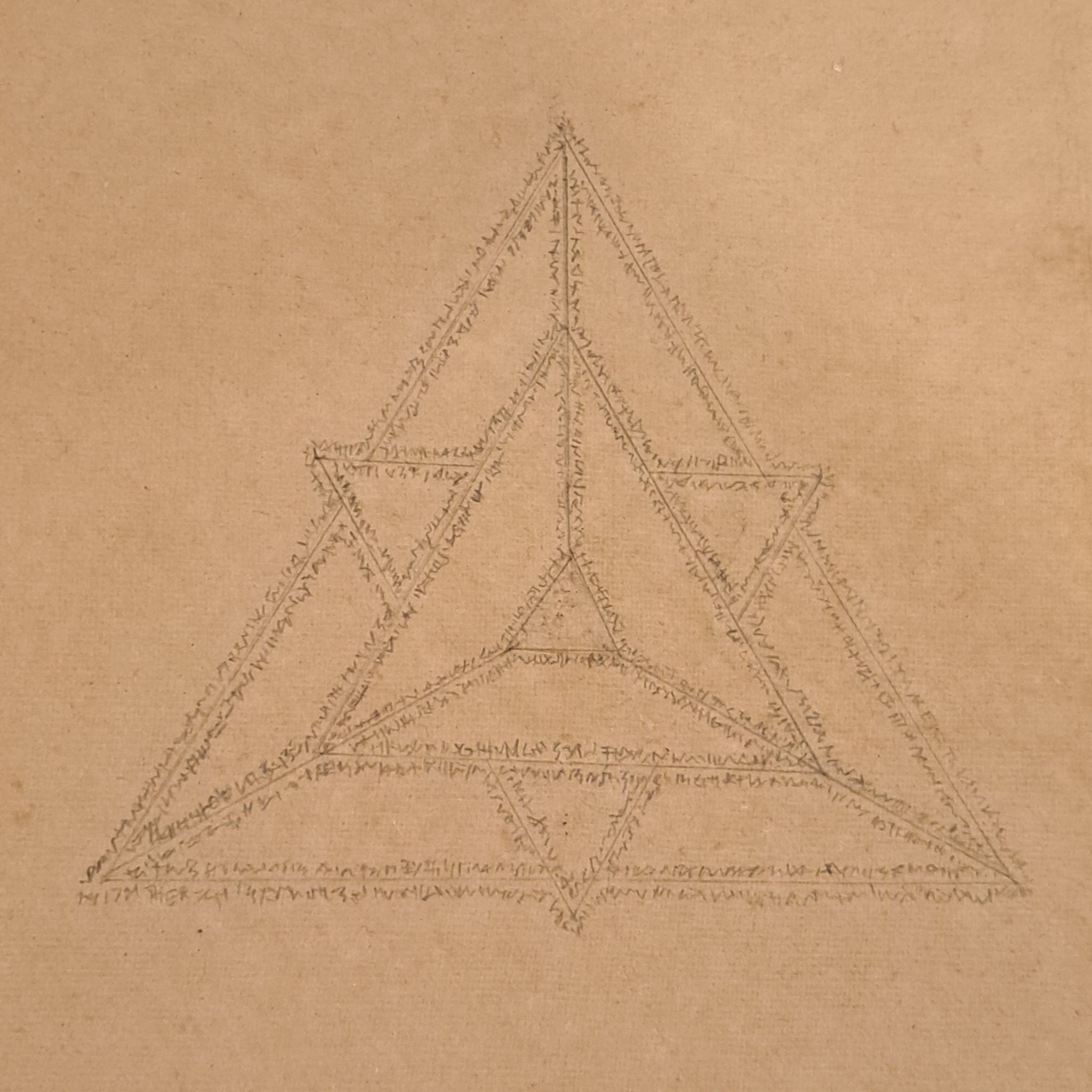
By the end of the outlining stage, the design might have all the shapes necessary for the sigil, but no text:

The next step would be transcribing the glyphs for the spell along the guidelines:

This is the most arduous and time-consuming part of creating the sigil, since a single one may require hundreds or thousands of glyphs.

As mentioned in Part 1, each graphomancy sigil is a miniature, symbolic representation of a cosmos, with each stroke representing a person, each glyph representing a settlement, and so on.
(Note: The glyphs in these sketches are not accurate to the canonical symbols I’ve established, simply because it would take days to transcribe)

A graphomancy sigil does not represent the cosmos as it exists—it represents the fragment of a new cosmos that will merge with the current one. In this way, looking at a graphomancy sigil is like looking at a single puzzle piece and fitting it into the larger puzzle of the cosmos.
One misplaced or forgotten glyph can ruin a spell, although the rigid symmetry of the sigil turns it into something similar to a sudoku puzzle—each side will have the same number of glyphs, so a mage can tell immediately if they’ve missed one.
Sigils can be placed on an object, in the pages of a book, or on a portion of the mage’s body. In the world of OROBORO, drawing sigils on one’s skin is particularly common, since many spells are crafted to alter or augment a person’s body.
Casting the Spell
At the end of the transcription, the mage usually places their own personal glyph (which is unique to them) to complete the sigil, which “empowers” it. This step is when the mage’s soul confers power to the sigil, but it’s also the step that damages the mage’s body or mind.
The more complex or powerful the spell’s effect, the more harmful its casting is on the mage. The rule of thumb is that the more discrete shapes the spell incorporates (circles, squares, spirals, triangles, etc), the more dangerous it becomes to cast.
The physical and mental effects of drawing a spell range can be severe, such as hemorrhaging blood, organ failure, memory loss, or hallucinations, or relatively minor, such as exhaustion and fever or disorientation and paranoia.
The negative effects of spellcasting are influenced by the esoteric ‘gates’ of the body and mind, but this should be the topic of its own blog post in the future.

Once a sigil has been empowered, it can be activated by “dragging” it off a page, the body, or a surface with a finger or stylus and pulling it into the air, where the sigil becomes illuminated and dissolves into the cosmos.
A sigil can also be cast by speaking a word, making a gesture, or another action on the part of the mage. These ‘triggers’ are usually incorporated into the spell itself. Either way, once cast, the sigil dissolves, forcing the mage to transcribe anew if they wish to cast it again.
This idea of graphomantic sigils being one-use was inspired by the Tibetan sand mandalas, and places a heavy restriction on graphomantic magic.
Conclusion
When crafting graphomancy, I had an image in my head of a scholarly kind of mage, hunched and solitary, carefully transcribing esoteric shapes and occult symbols into the pages of a grimoire.
Graphomancers, I imagined, would not be worldly sages and travelers of the wilderness, like the Finnish Vainamoinen—they would be academics, like Heinrich Faust in Johann Wolfgang von Goethe’s Faust.


While looking through an English translation of Faust, I found a passage that lines up eerily well with graphomancy. In the scene, Faust opens a book of magic and sees the symbol of the “Macrocosmos”. He remarks:
Am I a god? Light grows on this page—in these pure lines my eye can see creative nature spread in front of me
I imagine a graphomancer seeing the symmetry and neat, ordered lines of a sigil and thinking something similar—perhaps with the same tinge of hubris.
In Part 3, I plan to talk about how I adapted graphomancy for use in my stories—an important step that bridges the divide between abstract worldbuilding and concrete storytelling.
Leave a Reply