
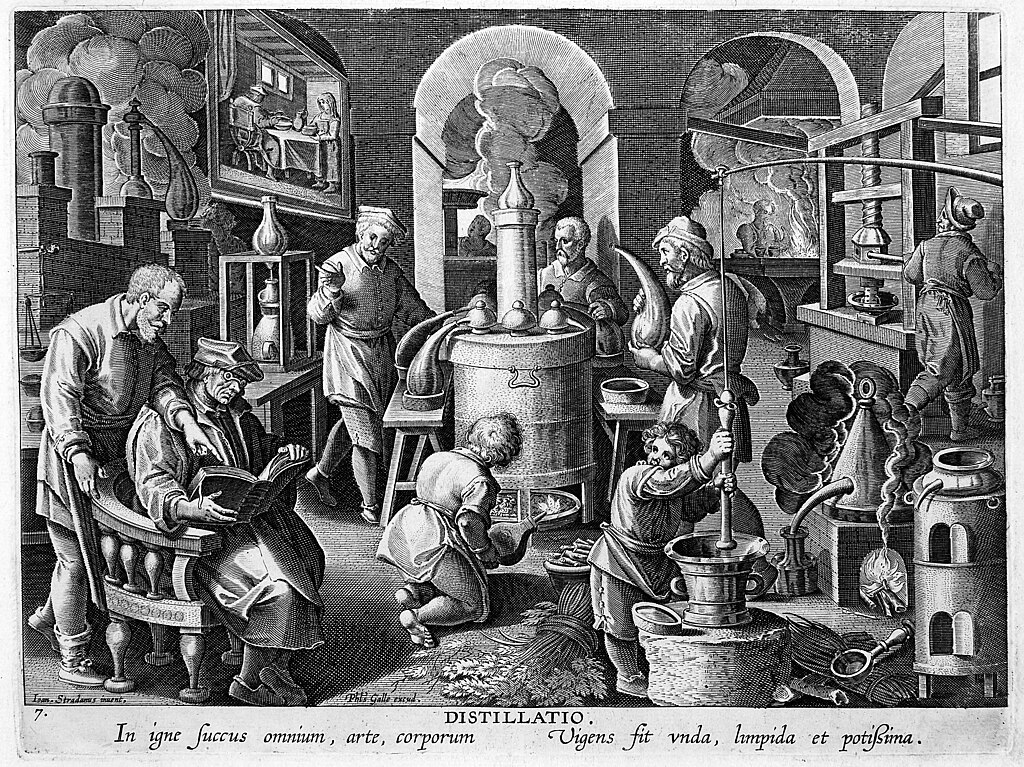
Welcome back to this article series on perfection and immortality!
In Part 3, I talked about the link between swordsmanship, self-cultivation, and perfection, with a particular eye toward paradox. If you haven’t read Parts 1-3, click on the links below.
Part 1: The Paradox of Perfection
Part 3: Swordsmanship & Perfection
In Part 4, I want to talk about alchemy. It’s hard to imagine a practice more different from swordsmanship than this, and yet experimentation with mercury, sulfur, and gold also became a vehicle to explore human perfection.
Note: Before we get started, I want to clarify that my understanding of alchemy, its philosophy, and its history is limited. I apologize for misrepresenting any details or concepts I talk about below.


Most pop depictions of alchemy portray its chief concern as turning lead into gold. The Elixir of Life, a potion that grants immortality, usually shows up as an associated goal of alchemy, but the connection between the gold and immortality is usually left unexplained.
Historically, hermetic alchemy has much more esoteric goals than producing material wealth. In broad terms, the goal of the hermetic alchemist was to achieve the perfection of the self, which was usually synonymous attaining unity with the One (a concept that can be philosophical, religious, or both).
The hermetic alchemist’s pursuit of transforming base metals into gold (which represented perfection) was meant to be a practical way of unearthing the physical laws of the universe, which would allow the alchemist to divine the path by which a person could be perfected.

Macrocosm & Microcosm
But why use chemistry and metals as the route to discover human perfection? What was the perceived connection between the material world and the spiritual world?
The answer comes in the form of the Emerald Tablet, an ancient text attributed to Hermes Trismegistus, the legendary founder of the alchemical tradition. I’ve presented Brian Cotnoir’s translation of a portion of the Tablet below:
A Truth without doubt, wholly sound
That the highest is from the lowest
And the lowest is from the highest.
The working of wonders is from the one
Just as all things came from the one
By a single governance
…
With skilled work and restraint
It will ascend from Earth to Heaven
And descend from Heaven to Earth.
And within itself is the power of the highest and of the lowest
Within it is the light of the lights
Therefore darkness flees from it.


These lines are the source of the phrase “as above, so below”, which is usually interpreted as referring to the microcosm (the individual or the human body) and the macrocosm (the world or the universe).
The ideas that:
a) each person is a miniature representation of the cosmos or contains within them the essential nature of the cosmos and
b) the wider cosmos’s structure or essential nature mirrors humanity
…provide an explanation to why the alchemists’ search for inner perfection caused them to investigate the external world. For them, both the inner and outer worlds obey the same (metaphorical) laws. Through studying nature, we study ourselves.
Apart from that, the concept of “as above, so below” represents a unity of seeming opposites: imperfect matter has, hidden within it, the potential for perfection.
The Magnum Opus
The goal of hermetic alchemy was to complete the Magnum Opus, “the Great Work”, whose end goal is usually identified with the Philosopher’s Stone, which literally or metaphorically granted immortality (it was also generally symbolized by gold). For hermetic alchemists, the Magnum Opus was the achievement of perfection, enlightenment, and unity with the One.

According to Alexander Roob:
“In reference to the divine work of creation and the plan of salvation within it, the alchemistic process was called ‘The Great Work’. In it, a mysterious chaotic source material called materia prima, containing opposites still incompatible and in the most violent conflict, is gradually guided towards a redeemed state of perfect harmony, the healing ‘Philosopher’s Stone’ or lapis philosophorum…”
I think it’s important to note that the beginning point of the Magnum Opus, a microcosm of the creation of the universe, begins with a material made of ‘opposites’.
The Magnum Opus involves many stages, though the number and nature of these stages vary depending on the author and philosophical tradition. According to one scheme, there are twelve steps, which involve various chemical and esoteric processes:
1. Calcination
2. Solution (or Dissolution)
3. Separation
4. Conjunction
5. Putrefaction
6. Congelation
7. Cibation
8. Sublimation
9. Fermentation
10. Exaltation
11. Multiplication
12. Projection


I won’t go too deeply into the specifics of the process, but I will touch on a few major elements:
Many texts mention the use of a globe-shaped retort (a glass vessel used to hold the material involved in the process) and an oven, which is used to heat the retort. This retort becomes a symbolic representation of both the world and the human skull, unifying the macrocosm and the microcosm, and the processes contained in the retort mirror the creation of the world and purification of the human spirit.
Sulfur and mercury are two of the key materials that are placed in the retort, usually represented as the Sun and Moon—opposites. These two undergo multiple phases of joining and separation, as well as combination with other materials. Through successive stages of distillation, dissolution, putrefaction, and other processes, the contents of the retort are gradually brought closer and closer to the transformation into the lapis, the Philosopher’s Stone.
Paradox & Unity of Opposites
To circle back to the theme of paradox once more, I want to return to the Emerald Tablet:
A Truth without doubt, wholly sound
That the highest is from the lowest
And the lowest is from the highest.
In these lines, we have a paradox: how can the high (all things divine, perfect, and harmonious) be ‘from the lowest’ (the mundane, imperfect, and chaotic) and vice-versa?
This question takes us back to Part 1, when I asked: “How can you make something perfect out of something imperfect?”
The answer, as provided by hermetic alchemy, seems to be that these seeming opposites—high and low, divine and mundane, perfect and imperfect—are two sides of the same coin, and that only by realizing the unity of these opposites can we transcend them and achieve immortality, embodied by the Philosopher’s Stone.

On its face, this transcendence is a radical and counter-intuitive concept: it rises above all opposites, including perfection. It’s somewhat similar to asking a person from a two-dimensional world to imagine a third dimension.
But this is exactly what we’ve been talking about on the way to Part 4:
In Part 2, we talked about fractals, whose infinite contours are measured in a dimension somewhere between the second and third. The relatively simple, finite patterns of a Sierpinski Gasket or Dragon Curve contain within themselves a hidden symmetry that allows them to create infinitely self-similar, perfectly nesting patterns.

In Part 3, we talked about overcoming the dualism of “self” and “other” to align oneself with the all-encompassing order of nature, which unites the two and transcends them. By achieving this, a swordfighter can achieve the ideal of perfect invincibility without needing to fight at all.

From the perspective of this transcendental realm beyond opposites, the concepts of high and low, self and other, microcosm and macrocosm, are all part of one grand unity, unbroken and whole. This unity represents a higher form of ‘perfection’, one that represents the totality of existence.
It is limitless, because it has transcended all limits—thus, it is infinite.
It encompasses everything this was, is, and will be, because all things are inextricably connected through the chain of cause and effect—thus, it is eternal.
We can call it ‘perfect’, but even that word is not enough to describe it, because all language is built on the idea of distinguishing one thing from another—in the words of Meister Eckhart, “As long as I am this or that, I am not all things”.
Conclusion
To summarize: paradox presents two opposing forces into a seemingly irreconcilable conflict, but this seeming deadlock contains within itself a hidden third path that provides a route to transcend the two conflicting forces.
The unity of opposites and the transcending of dualism is the key to obtaining perfection, and thus immortality. This transcendental “perfection” is what I meant in Part 1 when I said:
“In my mind, immortality, eternity, infinity, and perfection are all overlapping topics. To be immortal is to be eternal and infinite, and to be truly unending means being perfect.”
If you’ve read this far, congratulations on arriving at the conclusion of a long and winding path. However, we’re not quite finished—I wanted to talk about how I work immortality into fiction, and the other thing I said in Part 1:
“The main reason eternal life terrifies me is because I am not perfect.”
Leave a Reply