
This is part of a series of essays reflecting on my writing and my dark fantasy setting, called OROBORO.
When I was in middle school, I saw the Studio Ghibli film Princess Mononoke. Set in medieval Japan, it follows Ashitaka, a young man who becomes cursed by a monstrous beast. Two quotes from that movie stick out in my mind.
The first is from Jigo, a cynical spy posing as a monk:
“These days, there are angry ghosts all around us – dead from wars, sickness, starvation – and nobody cares. So you say you’re under a curse? So what? So’s the whole damn world.”


The second comes from Osa, a leper:
“Life is suffering. It is hard. The world is cursed. But still, you find reasons to keep living.”

If I were to point to anything as the bedrock for my worldbuilding and stories, it would likely be these two quotes. To me, they represent two perspectives on suffering in the world:
The first is to resign oneself to the idea that the world and its people are beyond salvaging, that nothing will change, and so you might as well embrace the depravity, cruelty, and selfishness that surround you.
The second is to hold onto hope that things can change, that people are capable of goodness, or love, or understanding, and that, in the face of everything, you have to keep trying.
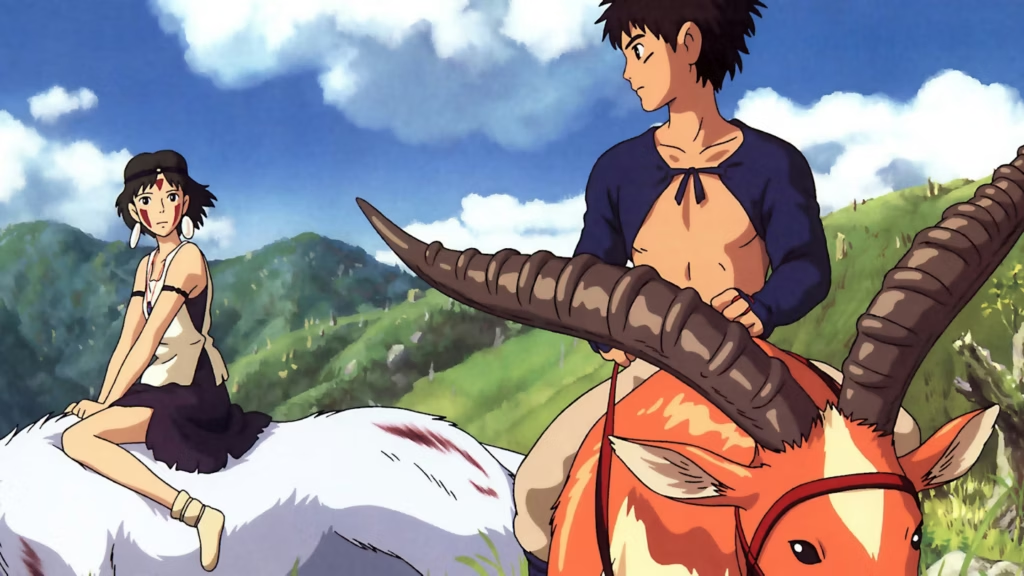
Princess Mononoke was the first film I’d seen that evoked the wonder and terror of old myths and legends, as well as the sense of reverence that permeated those tales. The world felt deeper, older, and more full of mystery than most other fantasy stories I’d come in contact with.
However, there was one fantasy series that evoked the same wonder and terror: A Wizard of Earthsea and its sequels, especially The Tombs of Atuan and The Farthest Shore. Wizard of Earthsea reminded me of figures like Vainamoinen and Gwydion, and its wisdom ran deep.
Here’s a quote:
“It is no secret. All power is one in source and end, I think. Years and distances, stars and candles, water and wind and wizardry, the craft in a man’s hand and the wisdom in a tree’s root: they all arise together. My name, and yours, and the true name of the sun, or a spring of water, or an unborn child, all are syllables of the great word that is very slowly spoken by the shining of the stars. There is no other power. No other name.”

By the time I read Wizard of Earthsea, I’d already immersed myself in folklore and mythology, which led me to books like The Hero With a Thousand Faces and The Golden Bough. Those books drew connections between stories, rituals, cosmology, and divinity, and became some of my first encounters with Buddhism.

To me, Earthsea wasn’t just an engrossing fantasy story, it was a beautiful, melancholy depiction of the struggle to nurture harmony in the world, an imperative born from the simple, powerful knowledge that all things are connected. Whether it was called the Dao, the Middle Way, or the Hero’s Journey, Earthsea illustrated a profound wisdom.
However, in high school, I encountered another, very different piece of media: Apocalypse Now. During the famous confrontation with Colonel Kurtz, half-hidden in shadow, I could hear echoes of wisdom in his words—the rejection of duality, the transcendence of opposites, and distaste for lies and illusions. But the more he spoke, the more I realized his words were only a dark reflection of those concepts.
Here’s a small excerpt from his speech:
“I’ve seen horrors…horrors that you’ve seen. But you have no right to call me a murderer. You have a right to kill me. You have a right to do that…but you have no right to judge me. It’s impossible for words to describe what is necessary to those who do not know what horror means. Horror. Horror has a face…and you must make a friend of horror. Horror and moral terror are your friends. If they are not then they are enemies to be feared. They are truly enemies.
The Golden Bough sat on Colonel Kurtz’s nightstand, and when he talked about being shot through the forehead with a “diamond bullet”, I recognized the reference to the vajra, the diamond thunderbolt of esoteric Buddhism. The vajra was a tool of enlightenment, but Kurtz’s enlightenment had gone horribly, horribly wrong.
One of the goals of my work with fantasy is to evoke the “sublime”, which characterized by both wonder and horror. This quote from Franza Kafka sums it up pretty well (at least for me):
The truth is always an abyss. One must — as in a swimming pool — dare to dive from the quivering springboard of trivial everyday experience and sink into the depths, in order to later rise again — laughing and fighting for breath — to the now doubly illuminated surface of things.
For me, that “double illumination” comes from seeing both sides of the world: the horrific, the corrupt, the bleak, as well as the wondrous, inspiring, and beautiful.
Likewise, Princess Mononoke, Wizard of Earthsea, and Apocalypse Now have all had a profound influence on my world and stories, because all of them touch on the two sides of humanity’s dual nature: its capacity for love, empathy, wisdom, and its capacity for delusion, selfishness, and horror.
Leave a Reply