
For most people, the narratives of FromSoftware’s games are (understandably) treated as kind of a joke. I don’t think anyone denies that an incredible amount of time and care is put into building these stories, but when unearthing them involves deciphering the purposely cryptic description text of a necklace hidden in some god-forsaken niche in a maze-like castle, it’s hard to imagine that it’s worth the trouble.

Bloodborne is no exception. Looking back on forum posts piecing together the game’s narrative, they sound like the kind of conspiracy theories that claim JFK left hints to his killers’ identities in the crossword puzzle of the Dallas Morning News.
But something very special came out of those discussions: The Paleblood Hunt, one person’s attempt at building an authoritative account of Bloodborne’s narrative, history, and lore. I’ve read the whole document, and I’ve walked away with a genuine appreciation for the depth and intricacy of the game’s worldbuilding and story.

As other people have observed, the biggest trick Bloodborne pulls off is making you think that it’s a survival horror story about blood, disease, and beasts, when it’s actually an eldritch horror story about nightmares, dreams, and transcendence.
The magic of the trick is that you, the player, slowly uncover this as the player character does, but once you discover the truth, you realize clues were always in plain sight—in the Cthulhu-like statues of the Grand Cathedral, the blood vials you use to heal, and the ethereal little pocket-realm you travel to in order to level up and improve your weapons.


What’s even more impressive is that the blood, disease, and beast stuff doesn’t become discarded once the eldritch stuff is introduced. Instead, it keeps getting developed, showing how the two are intertwined. This is because Bloodborne’s worldbuilding, narrative, and themes are all interconnected.
To explain what I mean, I’ve written up an analysis. Before I begin, though, I want to disclaim that if I misrepresent or misconstrue any of the nuances or ideas in The Paleblood Hunt, I apologize–I’ve tried my best to condense and summarize the info for an audience that isn’t familiar with it, and sometimes that means simplifying things.
Bloodborne: A Plot Summary
Even if the way Bloodborne presents its narrative and worldbuilding is intentionally obscure, there are things to be learned, conceptually, about how to structure a deep fantasy world and craft an elegant, effective narrative. To keep this analysis focused, I want to focus on the Hunters, the closest thing this game has to protagonists.
Let’s start with a summary of Bloodborne’s plot (or at least part of it), but cut away anything that doesn’t apply to Hunters.
Yharnam & the Beast Plague
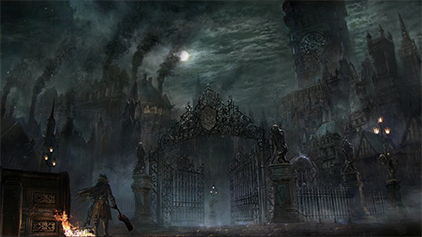
The narrative begins in the sprawling gothic city of Yharnam. The player character is a foreigner who came to Yharnam to see if the city’s famous Healing Church can cure their unspecified illness. Hunters are introduced as a militant organization that fights against the monsters that periodically appear in Yharnam during outbreaks of the “beast plague.”


The protagonist is given the role of Hunter by a mysterious old man called Gehrman and told to join the Hunt for these beasts. At the same time, Gehrman gives the protagonist access to the Hunter’s Dream, a mysterious little pocket-world that serves as a safe haven to rest and re-equip. We’ll return to the Hunter’s Dream later.

?file=Image-bloodborne-c01.jpg)
As the game progresses, you soon realize that other Hunters aren’t immune to the plague—in fact, the Hunt seems to drive Hunters mad with violence and bloodlust, turning them into horrific beasts. Even the clerics of the Healing Church, the organization that rules Yharnam and presides over the Hunts, seems to have succumbed to the plague. Even more troubling, the miraculous ritual blood administered by the Healing Church, which is used throughout Yharnam both medically and recreationally, appears to be the cause of the Beast Plague.
The Backstory of the Hunters
As the game goes on, you learn that Hunters weren’t always defenders of Yharnam. Originally, they were the clandestine agents of organizations that sought a path to enlightenment and transformation for the human race. One of those organizations is the Healing Church, who built their religion around a mysterious, seemingly miraculous substance called “the Old Blood” and sought to commune with higher powers through rituals.

In the Old Hunters DLC, you learn how Byrgenwerth Academy went about seeking their path to enlightenment: they investigated a fishing hamlet of people infested with parasites left behind by a dead eldritch being called Kos. These eldritch beings are called Great Ones, and live in a realm called the Dreamlands. The Hunters thought that these villagers might represent a nascent form of human ascension, granted by their encounter with Kos. So the hunters killed the villagers and searched their brains for eyes, a sign of enlightenment, and killed Kos’ infant child to loot its organs for experiments.

The Hunters’ desecration of Kos and their slaughter of the hamlet brought down a curse on them, which eventually trapped their spirits in a nightmare realm called the Hunter’s Nightmare. In this way, the events of the hamlet represent a kind of original sin that forever haunts all Hunters, including those employed by the Healing Church, who are descended from those old hunters.
The ruthless, blood-soaked ‘investigation’ into the fishing hamlet mirrors the bloodlust and madness of the hunters in Yharnam, suggesting that Hunters themselves are the worst monsters of all, and hence no different from the beasts they would eventually hunt.
The Great Ones
The bloodshed in the fishing hamlet did bear fruit for Byrgenwerth’s scholars: an umbilical cord looted from Kos’ child granted insight into how a human being could ascend to become a Great One. This allowed Byrgenwerth to create a being called Rom, the Vacuous Spider, a nascent Great One that was once a human being.

It’s also revealed that the “Old Blood” used by the Healing Church is actually the blood of a Great One (or their Kin), and that the ‘higher powers’ they worship are in fact the Great Ones.
What’s more, the protagonist is not just another Hunter trying to quell the Beast Plague—according to The Paleblood Hunt, the protagonist is being subtly manipulated to serve the will of a Great One called the Moon Presence, and part of the Moon Presence’s plan involves killing Rom.

Breaking It Down
The summary above is abridged, but it covers enough of Bloodborne to give us something to talk about.
Narrative
First, let’s start with the narrative. From a big picture perspective, Bloodborne has a pretty good premise—a protagonist is caught in the middle of a catastrophe and has to find a way to survive, but ends up unraveling a deeper mystery beneath the catastrophe.
In Bloodborne, there’s a natural way to introduce the setting and worldbuilding (because the protagonist is an outsider to Yharnam and its ways), there’s a consistent source of tension (surviving the night of the Hunt), and there’s a mystery to drive the plot (what is the cause of the Beast Plague? What role do the Great Ones play in it?).

So far, the key elements of the plot are:
- The Great Ones
- Kos
- Rom
- The Moon Presence
- The Healing Church/the Old Blood
- The Beast Plague
- The Hunters
- Byrgenwerth
So, how are these elements interlinked?
- Both the Healing Church and Byrgenwerth are striving to find a way for humanity to ascend to a higher state of being by studying the Great Ones.
- The Great Ones are worshipped by the Healing Church, and it’s the Blood of a Great One (or their Kin) that the Church uses to heal its adherents.
- The Beast Plague is caused by the Healing Church’s Blood.
- The emergence of the Beast Plague is what causes Hunters to shift from covert agents to exterminators who defend the city of Yharnam.
- The Great Ones are also researched by Byrgenwerth Academy, who encountered the deceased Kos in the fishing hamlet and looted the organs of its child.
- The scholars of Byrgenwerth later created their own nascent Great One, Rom.
- The player character is a Hunter that has been chosen by a Great One to play a special role in its plans, and it involves killing Rom.
The map of connections looks like this:

Now, this map isn’t complete, but even this abridged picture of Bloodborne’s narrative elements shows how closely the different elements are linked together and how everything links back to the Great Ones.
The cherry on top is that the Great Ones connect directly to the protagonist in the here and now, not just organizations in the past. This remedies a problem that shows up in a lot of fantasy stories, where the worldbuilding is strongly shaped by gods or deities, but those deities don’t play a significant role in the plot and have little or no relationship to the protagonist.
This lays the groundwork to talk more about Bloodborne’s themes and worldbuilding, which will happen in Part 2, along with what things writers can take from it to improve their own worlds and stories.
Note: Again, I want to say that I’ve done my best to present the information from the Paleblood Hunt accurately, but some things (like the fact that the discovery of Kos’ carcass shaped the Healing Church as well as Byrgenwerth, or that the blood used by the Healing Church may more accurately be attributed to Kin of the Cosmos) have been omitted or simplified.
If you want the full story, read the Paleblood Hunt here and give thanks to Reddit user Redgrave!
Leave a Reply